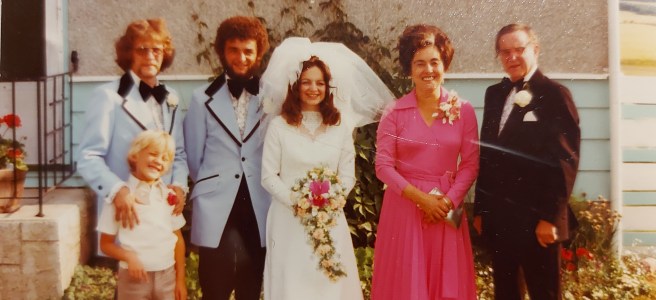
My grandmother was an Indigenous woman, and I have only begun to fathom what this means.
She could have been described as a “non-status Indian” then, but she never spoke to me of that “heritage” and its importance. And neither did my Dad, her son, for that matter. He has always seemed white to the core.
To me now, 23 years after Grandma’s passing, it is clear to me that she was a racialized woman. At the time though, she was a white woman and mine was a white family. I was a white boy who became, slowly and quite painfully, a white man. I had blond hair no-less, someone of European, mostly Irish, descent. Descended from, and I gag now to say it, settlers and colonizers. My only sibling – my brother – and I, were blue-eyed, blonde boys, born to a man who was also a blue-eyed, blonde-haired boy, but who was born to a dark-featured Métis woman.
How could I have not seen, not known, that she was not just white? What kind of people don’t discuss or acknowledge who they are, the culture that they are from, or share stories about it? Where was the pride? I think it is important to say that at some point, as a boy, I became aware of it. At least, I possessed a notion. But why did I forget or not care or not take this interest then? She did not seem coloured. In fact, I remember her as pasty faced. She wore a lot of make-up (and sometimes a wig apparently). Throughout my childhood, she owned and ran a ladies wear store up north. She was glamorous. And she seemed like white people.
I don’t remember interacting much with her husband, Frank. I remember him leaning back in his brown rocking recliner, next to the fireplace at their house in Dawson Creek, facing the TV or gazing out the big bay window in the living room onto the Prairie landscape. Sometimes his bottom lip would be bulging with snuff. Sometimes he would be blowing, but not whistling, an unknown tune through his pursed lips. Looking distant. He was arthritic and never very mobile from what I remember, perhaps because of that friendly-fire WWII injury that they mentioned. He was some 20yrs older than Grandma. But I am convinced that I did talk to him, despite how withdrawn I would become in my youth. I have this impression that I did hold a genuine unadulterated curiosity about things and people until some point, as a kid. And I believe I did ask him about himself. I am unclear on what, if any, kind of emotional connection there was between us.
I vaguely remember someone, Grandma or one of my parents, asking or telling me not to call him “Grandad” anymore. Being asked this felt bad, uncomfortable in my stomach. The real emotions were confusion, fear, and more recognizably now – shame. You know, the sense that I got was that I had done something wrong, to him. Or he did not like me. That’s what this child assumed and felt in that vacuum of information and support.
I have memory of him giving curt instruction from that reclined position, presumably to someone in the household of the female gender identity, to reign in the raucous play of my little brother or younger cousins while he was sitting in that chair. He would not be having that. I maintain a distinct impression that he was of the view that children were to be seen and not heard. Discipline was to be maintained. I eventually learned that Frank had abandoned a partner and child in England before coming to Canada and marrying my Grandmother. Dad has referred to his step father as an ornery and miserable old bastard; nonetheless, he repeatedly venerated or joked about his step-father when recollecting events. This is now unsurprising to me, this type of family-colonizing Stockholm Syndrome.
And along the course of my life there has been a smattering of anecdotes, and the odd photo to accompany, which may support the narrative that I am putting together now. But the timeline in which I learned of them as a child is also fuzzy. I find that interesting but also unsurprising. It parallels what I have learned about dissociation. Your experience of time is often altered when you are terrified and dissociated, they say. I have an inkling, in my gut, that I was mildly traumatized from that don’t-call-me-Grandad event. It was these quiet, confused and guilt-evoking moments. I can’t argue that the experience was violent, but could it still have been just this?
There was one funny photo. Dad actually had a grin on his face, and it seemed to show his arm or a stick reaching out toward the taker of the photo. He had shaved most of his head and given himself what family and friends back then could interchangeably label a Mohawk or an Iroquois cut, characterizations that I now know are racist. The story that accompanied the photo was that Grandma had kicked him out of the house for getting it. I do not know if he has ever been able to see the utter irony or significance of doing that to himself.
My guess would be that he was around 16 years old at the time. This was also around the time that I understood he had to approach Grandma & Frank for his own birth certificate, which was required for some extracurricular or school activity, only then to learn that his real father was… not Frank. To me, it all makes some sense now. He was teenager in pain and confused about his identity. Coincidentally or not, in my family “of origin”, we have seldom verbalized our emotions or expressed them directly. I think it is safe to say now that we often did not even really, fully feel our feelings, and they have continued to manifest in harmful or awkward ways.
Jump forward to my own early 40s, that is, just in these last 10 years. I don’t know how the topic came up. I was visiting Mom and Dad and the 3 of us were at the table during or after a meal, and he tells me of the occasion when Frank was once seriously ill in hospital, out-of-town in the Big City, and Grandma subsequently had to be institutionalized for what they used to call a “nervous breakdown” in the day. Dad refused an offer of help from an adult family friend who wanted to move into their home and look after him and his two younger siblings. He refused the offer and looked after them himself. This event also happened to occur when he was around 16. I was stunned not to have been told this before, as if my Dad believed it was not at all relevant to who he was and to who we are. To the choices that he would subsequently make that have affected all of us.
But all the pieces seemed to connect in a way. I remembered other things. How he joked about jumping out from behind something in the yard or garden and startling Frank, and Frank reacted by turning and hitting him on the head. With a hoe. Dad had laughed and shared it as oh-what-a-mischievous-child-I-was. Somehow, I filed away, down deeply, how he told me that on another occasion Frank had beaten him so badly that he had to miss school. And on another occasion he said Frank went after my uncle, and Dad stepped in front of Frank and held him off. I don’t want to subscribe too closely to either his or my own childhood memories, or the derived narratives of these tellings. But shit happened to my Dad. Trauma happened. To us.
I don’t know how or when I learned that we had Indigenous ancestry and were affected by racialization. It seems that I should though. I know I could have inquired with Dad or Grandma. The idea just brings up discomfort and fear, because it is the type of subject we did not discuss. Or it is a topic about which they would not acknowledge as relevant. It didn’t ever seem that Grandma was a “native” woman when she was alive. I don’t specifically remember Dad talking about it with me, or about painful experiences. And I am that sure she did not. It seemed our limited time with Grandma had to be spent being spoiled as Grandchildren and being treated somewhat superficially.
She always dressed quite glamorously, as I viewed it, and she ran that store in downtown Dawson Creek for 25 to 30 years, after they moved from Williams Lake but right before Dad graduated high school. I believe Dad once characterized it as being abandoned or left behind, with regard to the timing. He laughed at that too, when he told me. She seemed to wear a lot of makeup. But I think now of her distinctive cheekbones and how she talked. Maybe it’s morbid, but I still have a recording of her voice from the mid 90s on a cassette of incoming messages from my beloved Panasonic answering machine.
Remembering these circumstances has reminded me of just how much closer we always were to Mom’s family than Dad’s. We were close to her two siblings and were acquainted with the surviving Irish Great Grandparents, the Great Aunts and Uncles on her side, all living around the Coast, within a 5-hour drive from us, and close enough for multiple yearly visits. But Grandma and “Grandad” lived way up there throughout my childhood, some 10-plus hours away. I met my Dad’s grandmother once in my life, one of her sisters a few times, and have an inkling of the face of another uncle in the Cariboo.
We spent a few holidays with them in The Peace region. I remember one, just after I started playing minor hockey, where we visited and I skated with my Mom and Dad on the outdoor rink at the school across from their house. I remember another, when they took me to work and Grandma had me sit behind the front counter and press a button that would ring in the staff area anytime someone would enter the store.
In the summer of 1988, when I was 19 and trying to push out against the cloister of my mental illness, I decided it was important to buy a plane ticket and fly up on my own to Dawson Creek to see Grandma and Frank. I remember it for being the week of the big Wayne Gretzky trade. One day there, I joined them on an outing for errands in the car, when they made a stop and got out. I looked out the backseat side window to see them standing and talking to this native man, a brown person. I was to learn that this was Grandma’s brother Gordon, named after their white father. In the time since then, I have felt confused, but for years not curious or brave enough to inquire. About us. About me. Grandma was not a “brown” woman. Was she?
I eventually learned more about Dad’s Uncle Gordon, that Grandma and Frank “helped him out”, which I assumed was with money, or employment, or housing. I also heard that he had a negative relationship with alcohol. I think I knew but somehow lost the full story, or pretended that it just did not matter. He and Grandma were just two of 16 siblings. Sixteen! How could I have forgotten that? Why didn’t I hear more about the rest of those siblings? Where were the stories? Was it because it might not be possible to know or remember each of them? It seems significant now, and I feel a profound loss, pain, frustration, and shame at not having taken interest, asked Grandma myself, and heard it all from her when she was alive. But were she and Dad ashamed of them?
When Grandma died in the late 90s, I spoke at the commemoration of her passing. I was the oldest grandchild, so maybe that should not have been a surprise to anyone, but speaking in front of large groups was daunting to me. My anxiety disorder went beyond shyness. I spoke of that glamour, the image I held of her when she used to smoke, exhaling smooth chem-trails from her nostrils, a dragon lady. My presentation that day was not actually very poetic, but I was motivated to be heard and to share my thoughts in front of strangers and family alike, of this important person who was iconic and mysterious to me. Doing it was also a side project of the therapy I was undertaking for Depression, at that time.
Why such an apathy about knowing and learning about my own family history? Sometimes I think I was just too self involved to care, so I ride a familiar trope, a pony of self flagellation. That supplements my deeply ingrained self esteem pathology all too well. That pathology, I am convinced, is partially rooted in an intergenerational trauma that I inherited from my Dad, the racism he witnessed toward his mother and her siblings. It was directed at my Dad, Grandma, and likely the generations of Great-relatives going back to the Métis Resistance events against Canada’s occupation. I can surmise the default question for them then could only be distilled to “why remember or relive hardships past – we put that behind us so that we could move forward”. Dad offered such a response when I inquired about his real father and wondered aloud about any interest he possessed into tracking the man down. “Fair enough” I resolve to myself sometimes, but I know that answers to questions about my own identity therein lay.
The emergence of the Reconciliation movement has been a part of the reason that I am grappling with this more recently. My Grandma and her siblings were survivors of racism. They internalized that racism, not wanting to be Indian, not seeing themselves as Native. When I finally started asking, I learned from my Auntie that Grandma was called a squaw when she was a young woman, at least one of her sisters was teased for speaking Cree, and their large family was spurned by my white Great-Grandfather’s parents, for a time. Dad eventually shared that his friends would comment about his Indian Uncles whom regularly visited and stayed. My illiterate Great-Great Grandfather Alexandre Desjarlais was legally issued Scrip and was defrauded of his rights and land. This is a significant reason why only now. Because now the story comes together, and I believe I have some minimal shared understanding.
 Glimpses & Notions of One Self